Builder Contract Red Flags: 9 Clauses That Could Cost You Everything
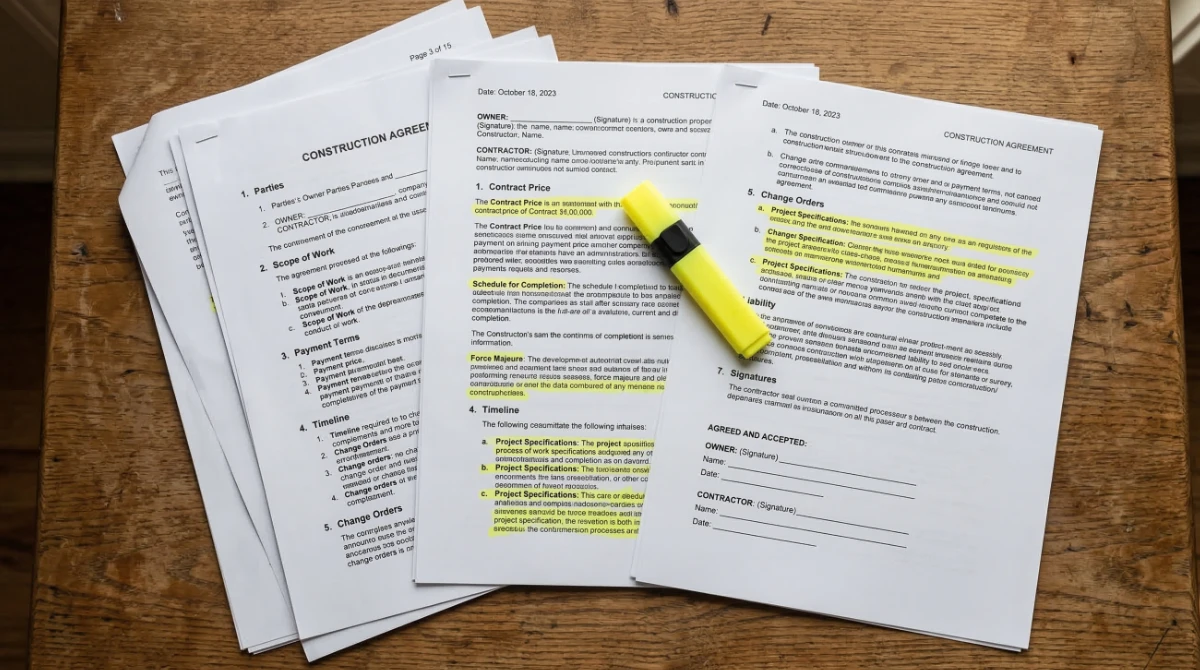
You've interviewed three builders. You've checked references. You've compared bids. And now the winning builder hands you a 20-page contract and says, "Take your time, look it over, and sign when you're ready."
So you flip through it. It's dense. Legal language you've never seen. Terms like "force majeure," "allowances," and "substantial completion." You sign it anyway because you trust the builder and you're excited to start.
Six months later, you're $47,000 over budget, the builder just charged you $800 for a change order you didn't approve, and your contract says you can't hire anyone else to finish the job. You look at the clause. It's right there on page 14. You signed it.
A builder contract isn't written to protect you. It's written to protect the builder. Your job is to know which clauses to push back on.
I've reviewed hundreds of builder contracts over 15+ years. The same dangerous clauses show up again and again. Here are the 9 that cost homeowners the most money - and exactly what to negotiate instead.
1
"Cost-Plus With No Cap" — The Blank Check Clause
Critical — potential exposure: unlimited
A cost-plus contract means you pay the actual cost of materials and labor, plus a markup (usually 15-25%) for the builder's profit and overhead. In theory, this is transparent. In practice, without a cap, you have zero control over the final price.
Translation: the builder can spend whatever they want, mark it up 20%, and hand you the bill. There's no maximum. No guardrails. No cap. If the builder is inefficient, hires expensive subs, or over-orders materials, you pay for all of it - plus the markup.
- Add a guaranteed maximum price (GMP) — the builder can come in under, but never over
- Require itemized invoices for every cost (not lump-sum billing)
- Include a shared savings clause — if the project comes in under the GMP, you split the savings 50/50 with the builder
- Cap the builder's markup percentage and define exactly what it covers
Cost-plus without a GMP is the builder's dream contract. They have zero incentive to control costs because every dollar they spend earns them another 20 cents in markup. I've seen cost-plus projects run 30-50% over the original estimate with no recourse for the homeowner. If a builder refuses to add a GMP, ask yourself why they need an unlimited budget.
2
"Allowances" That Are Deliberately Low
Critical — typical exposure: $15,000-$60,000+
Allowances are placeholder dollar amounts in the contract for items you haven't selected yet - cabinets, countertops, flooring, fixtures, appliances. The builder puts in an estimated cost, and you pay the difference when you make your actual selections.
The problem: many builders deliberately set allowances low to make the total contract price look competitive. Then when you go to select your cabinets and discover the "allowance" was $8,000 for a kitchen that realistically needs $22,000 in cabinets, you're on the hook for the $14,000 difference.
| Allowance item | Common contract allowance | Realistic cost | Your overage |
|---|---|---|---|
| Kitchen cabinets | $8,000 | $18,000-$35,000 | $10,000-$27,000 |
| Countertops | $4,000 | $6,000-$15,000 | $2,000-$11,000 |
| Flooring (whole house) | $5,000 | $12,000-$30,000 | $7,000-$25,000 |
| Light fixtures | $2,500 | $4,000-$12,000 | $1,500-$9,500 |
| Plumbing fixtures | $3,000 | $5,000-$15,000 | $2,000-$12,000 |
| Total potential overage | $22,500 | $45,000-$107,000 | $22,500-$84,500 |
- Ask the builder to price allowances at the realistic mid-range level, not the bare minimum
- Visit showrooms and get actual quotes for your selections before signing the contract
- Require that any allowance overages be approved in writing before ordering
- Get a breakdown of what's included in each allowance (labor, materials, or both?)
Low allowances are the oldest trick in the bid game. Builder A bids $350,000 with $8,000 in cabinet allowance. Builder B bids $375,000 with $22,000 in cabinet allowance. Builder A "wins" the bid - but when you select real cabinets, both projects cost the same. Builder A just hid the cost. Always compare bids with equalized allowances. For more on this, read my article on how to prevent change orders.
3
"Builder May Substitute Materials of Equal or Greater Quality"
High risk — quality & cost impact
This clause gives the builder the right to swap out the materials specified in your contract for alternatives they consider "equivalent." On paper, this sounds reasonable — supply chain issues happen. In practice, "equal quality" is subjective, and the builder decides what's "equal."
You specified Andersen windows. The builder installs a lesser-known brand and claims they're "equivalent." You wanted engineered hardwood flooring - you get luxury vinyl plank because the builder says it's "equal or better." You have no recourse because the contract gave them full authority to make substitutions.
- Require written approval for ANY material substitution, no exceptions
- Specify exact brands and model numbers in the contract specs, not generic descriptions
- Add a credit clause — if the substitute costs less, you get the savings
- Define "equal quality" with measurable criteria (warranty length, material grade, thickness, rating)
4
Large Upfront Payment (>10% Before Work Starts)
Critical — financial exposure
Some builders ask for 25%, 30%, or even 50% upfront before they swing a single hammer. Their justification: "We need to order materials." This gives them your money before they've earned it - and significantly reduces their incentive to stay on schedule or on budget.
- Tie payments to completed milestones (foundation, framing, rough-in, drywall, finishes, completion)
- Never pay more than 10% upfront — and only after permits are pulled
- Hold 10% retainage until punch list is 100% complete
- Require lien waivers from all subcontractors before each payment
A builder who needs 30%+ upfront either has cash flow problems or is using your money to finish someone else's project. Neither is good. A legitimate builder can fund material orders with their own credit lines. Your payments should follow completed work, not precede it. The golden rule: never let your payments get ahead of the work on the ground.
Know What to Look for Before You Sign
The Home Building Checklist Bundle includes a 17-page Hiring Contractor Checklist with 100+ items covering bids, contracts, payment schedules, red flags, and exactly what to verify before signing.
See the Checklist Bundle
5
"Time Is Not of the Essence" — No Completion Deadline
High risk — schedule & carrying cost exposure
Some contracts contain vague language about timelines — "Builder will complete the project in a reasonable timeframe" — or no deadline at all. Without a firm completion date and penalties for delays, the builder can take as long as they want.
That "10-14 months" with no penalty and an open-ended list of excuses means you could be 18 months in with no recourse. And every extra month costs you: mortgage payments on the construction loan, rent on your current place, storage fees, interest charges.
| Carrying cost | Per month | 3-month delay |
|---|---|---|
| Construction loan interest | $1,500-$3,000 | $4,500-$9,000 |
| Rent / temporary housing | $1,500-$3,000 | $4,500-$9,000 |
| Storage unit | $150-$400 | $450-$1,200 |
| Extended insurance | $100-$300 | $300-$900 |
| Total monthly carrying costs | $3,250-$6,700 | $9,750-$20,100 |
Liquidated damages clauses make builders nervous — which is exactly why you want one. It doesn't have to be punitive. $200-$300 per day is reasonable and simply covers your carrying costs. Any builder confident in their timeline should have no problem agreeing to this. If they refuse, ask them: "How long do you actually think this will take?" For more on preventing delays, read my article on how to avoid building delays.
6
Change Order Clause With No Price Cap or Approval Requirement
Critical — potential exposure: $20,000-$80,000+
Change orders are modifications to the original scope of work. They're sometimes necessary — but they're also pure profit for builders. The contract clause that governs change orders is one of the most important paragraphs in the entire document.
Notice two problems: (1) the builder can initiate change orders they "deem necessary" without your request, and (2) the 25% markup on every change is significantly higher than the typical 15-18% project markup.
Dangerous change order clause
Builder can initiate changes they "deem necessary."
25%+ markup on all change order costs.
No requirement for written approval before work begins.
No cap on total change orders.
Fair change order clause
ALL changes require written owner approval before any work starts.
Change order markup matches the contract markup (15-18%).
Builder provides itemized cost breakdown with every change order.
Emergency changes (<$500) allowed with verbal approval + written follow-up within 48 hours.
- Require written approval for ALL change orders before work begins
- Set the change order markup equal to the contract markup — not higher
- Require an itemized breakdown (labor hours, material cost, sub quotes) for every change
- Include a 72-hour review period for non-emergency changes
7
"Substantial Completion" Instead of "Final Completion"
High risk — punch list & quality exposure
"Substantial completion" means the house is livable but not necessarily finished. The builder can request final payment at "substantial completion" and leave you with a 50-item punch list that takes 3 more months to close out — if they close it out at all.
This means the builder gets paid in full while your kitchen has no handles, three outlets don't work, the paint has touch-up spots, and the garage door opener isn't installed. Once they have your money, the punch list becomes their lowest priority.
- Hold 10% retainage until the punch list is 100% complete
- Define a maximum timeframe for punch list completion (30 days)
- Include a clause allowing you to hire another contractor to complete punch list items and deduct from retainage if the builder doesn't finish in time
- Get your own inspection checklist to catch everything during the walkthrough
Retainage is the most powerful tool you have. That last 10% is the builder's profit on your project. Without it, they have zero financial incentive to come back and fix the squeaky stair, the crooked trim, or the sticky door. With it, they'll show up. Every single time. Never release final payment without a completed punch list.
8
Mandatory Arbitration With Builder-Selected Arbitrator
Serious — eliminates your legal rights
Many builder contracts include a mandatory arbitration clause — meaning if there's a dispute, you can't go to court. You must go through arbitration. That's not inherently bad. What is bad: when the contract lets the builder choose the arbitrator or the arbitration firm.
The builder has used this arbitration firm before. They know the arbitrators. They're repeat customers. You're a one-time participant. Guess who the arbitrator tends to favor?
- Require mediation first — it's cheaper, faster, and less adversarial than arbitration
- If arbitration is required, both parties should jointly select the arbitrator
- Never agree to binding arbitration with a builder-selected firm
- Preserve your right to go to court for disputes above a certain dollar amount
9
No Warranty — Or a Warranty That Covers Nothing
High risk — long-term exposure
Some contracts include a one-year "builder's warranty" that sounds reassuring but covers almost nothing when you actually read it. Others include no warranty at all, relying on the vague language "workmanship shall be performed in a workmanlike manner."
That exclusion list can swallow the entire warranty. "Failure to maintain" can mean anything. "Normal wear and tear" can cover cosmetic defects. And one year is often too short for structural issues or waterproofing failures that don't appear until the second winter.
| Warranty type | Industry standard | What to push for |
|---|---|---|
| Workmanship & materials | 1 year | 2 years |
| Major systems (HVAC, plumbing, electrical) | 2 years | 2-5 years |
| Structural (foundation, framing, roof) | 5-10 years | 10 years |
| Waterproofing (basement, exterior) | Often excluded | 5 years minimum |
- Get separate warranty periods for workmanship, systems, and structural
- Define exactly what "workmanship" covers - paint, trim, doors, windows, grading
- Remove vague exclusions like "failure to maintain" or define maintenance obligations specifically
- Consider a third-party home warranty (2-10 Home Buyers Warranty, etc.) for structural coverage
The warranty clause is where you find out how confident a builder is in their own work. A builder who does quality work will gladly offer a 2-year workmanship warranty and a 10-year structural warranty. A builder who cuts corners will fight you on anything past 12 months. The warranty clause isn't just about protection — it's a character test.
Reviewing a Builder Contract?
The Home Building Checklist Bundle includes a 17-page Hiring Contractor Checklist covering bids, proposals, contracts, payment milestones, warranty terms, red flags, and 100+ items to verify before signing - plus a budget tracker to keep costs on track.
Get the Checklist BundleHow to Review a Builder Contract Before Signing
Before you put your name on the dotted line, run through this process. It takes a few hours and can save you tens of thousands.
Read the entire contract - every page, every paragraph
Not skimming. Reading. Highlight anything you don't understand. If a clause is confusing, it's probably confusing on purpose.
Circle every allowance and compare to real-world costs
Visit showrooms, get quotes, and compare allowance amounts to what you'd actually spend. If they're low, negotiate before signing.
Check the payment schedule against construction milestones
Payments should trail completed work by one stage. Never pay for work that hasn't been done yet.
Find the change order clause and understand every word
Who can initiate changes? What's the markup? Is written approval required? This clause will determine your budget exposure.
Verify the completion timeline includes a specific date and penalties
If there's no deadline with consequences, the builder has no incentive to finish on time. Your carrying costs are real.
Read the warranty clause and compare to industry standards
Separate workmanship, systems, and structural warranties. Check exclusions carefully. If the warranty is weak, negotiate or walk.
Have a construction attorney review it before you sign
$500-$1,000 for an attorney to review a $400,000 contract is the best insurance you can buy. They'll catch things you won't.
When you push back on contract terms, watch the builder's reaction. A good builder will say, "That's fair - let's adjust it." A bad builder will say, "This is our standard contract and we don't modify it." Any builder who refuses to negotiate contract terms is telling you exactly how they'll handle disagreements during your build.
What These Clauses Can Cost You
| Red flag clause | Potential cost exposure |
|---|---|
| Cost-plus with no cap | Unlimited (30-50% over estimate) |
| Low allowances | $15,000-$85,000 |
| Material substitutions without approval | $5,000-$30,000 in quality loss |
| Large upfront payment | Total deposit at risk if builder defaults |
| No completion deadline | $3,000-$7,000 per month of delay |
| Uncapped change orders | $20,000-$80,000+ |
| Substantial completion = final payment | $5,000-$20,000 in incomplete work |
| Builder-selected arbitration | Loss of legal protections |
| Weak or no warranty | $10,000-$50,000 in post-move-in repairs |
Every dollar you save by negotiating the contract is a dollar you'll never have to fight for during the build.
Build With Confidence From Day One
The Home Building Checklist Bundle includes 12+ detailed checklists covering every stage of construction, a budget tracker, and a materials list - 15 years of field experience in one download.
Get the Complete BundleFinal Thoughts
A builder contract is the blueprint for your entire financial relationship with your contractor. Every clause either protects you or exposes you. And unlike a floor plan mistake, a contract mistake can't be fixed with a change order — it is the change order.
Don't sign a contract you haven't read. Don't accept terms you don't understand. Don't skip the construction attorney. And don't assume the builder's "standard contract" is fair just because it's standard.
The 30 minutes you spend negotiating contract terms can save you more money than any other single decision in your entire build.
For more on hiring the right builder, read my 15 questions to ask your builder before signing. And to understand what a realistic budget looks like, check out my guide on the hidden costs of building a custom home.