How to Read Your Home Blueprints Like a Pro (Even If You've Never Seen One Before)
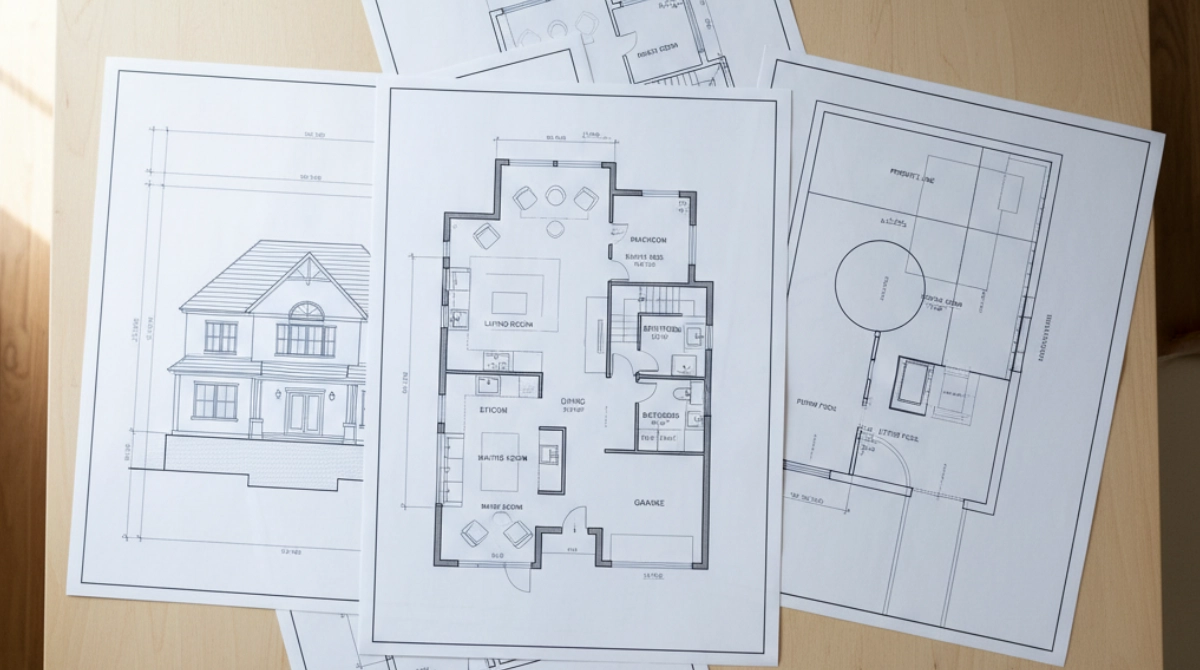
Your architect just emailed you a 14-page PDF. Page one is a title block full of codes you don't recognize. Page two is a floor plan covered in lines, arcs, dashes, and abbreviations that look like a foreign language. Page ten has something called an "electrical plan" that's just dots and squiggles.
You scroll through it, nod, and tell the architect it "looks great."
Four months later, you're standing in your framed house wondering why the master closet is half the size you expected, why there are only two outlets in the living room, and why the kitchen island is 6 inches too close to the wall.
Every single one of those problems was visible in the blueprints. You just didn't know how to read them.
This guide will teach you how to read residential blueprints from scratch - no architecture degree required. By the end, you'll know what every sheet is, what the symbols mean, and exactly what to look for before you sign off.
You don't need to understand every line on a blueprint. You just need to understand the ones that will cost you money if they're wrong.
What's Actually in a Blueprint Set?
A "blueprint" isn't one drawing - it's a set of 10 to 20+ pages, each showing a different system or view of your home. Here's what each sheet type contains and why it matters to you:
Sheet A0
Cover Sheet & Site Plan
Where your house sits on the lot
The site plan is a bird's-eye view of your entire property. It shows where the house sits on the lot, how far it is from property lines (setbacks), where the driveway goes, and how the land is graded for drainage.
What to look for:
- Setbacks - distance from the house to each property line. These are set by zoning code and can't be violated.
- House orientation - which direction does the front door face? Where does the sun rise relative to your master bedroom?
- Driveway location - does it make sense for traffic flow? Can you back out safely?
- Drainage arrows - water must flow away from the foundation on all sides
- Utility connections - water, sewer, electric, gas entry points
- Easements - areas where utility companies have access rights (you can't build on these)
The site plan is where I've seen the most expensive mistakes. A house placed 2 feet too close to a setback line means a variance hearing, attorney fees, and potential redesign. A driveway that conflicts with a drainage easement means tearing it out and re-pouring. Check this sheet carefully - or better yet, visit the lot with the site plan in hand and walk the property lines.
Sheet A1-A2
Floor Plans
The layout of every room on every level
This is the sheet most people think of when they hear "blueprint." It's a top-down view of each floor, showing walls, doors, windows, stairs, and room dimensions. One sheet per level (first floor, second floor, basement).
Key symbols to understand:
| Symbol | What it means | Why it matters to you |
|---|---|---|
| Thick solid line | Exterior wall | These are load-bearing - expensive to move |
| Thin solid line | Interior wall | Easier to move, but still costs $1K-3K after framing |
| Arc / quarter circle | Door swing direction | Check for conflicts - doors hitting each other or furniture |
| Three parallel lines | Window | Verify size, placement, and which rooms get natural light |
| Dashed line | Features above (soffit, beam, upper cabinets) | Shows overhead elements you can't see in a top-down view |
| Dimension lines with arrows | Room measurements | Verify room sizes match what you discussed with the architect |
| Stair arrow "UP" / "DN" | Staircase direction | Arrow points in the direction you climb |
Not checking dimensions against real furniture. A room labeled "12x14" sounds generous until you draw a king bed (76x80"), two nightstands (24" each), and a dresser (60") to scale. Suddenly there's no room to walk. Always draw your furniture on the plan before signing off.
For a deep dive into the most common floor plan errors, read my article on 10 floor plan mistakes that will cost you thousands.
Sheet A3-A4
Exterior Elevations
What the house looks like from each side
Elevations are straight-on views of each side of the house - front, back, left, and right. They show what the finished exterior will look like: roof lines, siding material, window placement, foundation height, and trim details.
What to look for:
- Window sizes and positions - do they look balanced? Are there windows where you expected them?
- Roof pitch and overhangs - steep roofs cost more, but overhangs protect walls from rain and shade windows from summer sun
- Foundation height - how high is the floor above grade? (affects entry steps and basement ceiling height)
- Material labels - siding type, stone/brick accents, trim details should be specified
- Ceiling heights - sometimes noted on elevations (9', 10', vaulted)
Elevations are where you catch aesthetic problems. That window that looked fine on the floor plan might be visually off-center on the elevation. The roofline that seemed simple might look awkward from the street. If your architect provides 3D renderings, compare them to the elevations. If they don't, spend extra time studying these sheets - they're the closest thing to seeing your finished house before it's built.
Sheet A5
Building Sections & Details
The house sliced in half to show what's inside the walls
Imagine slicing your house in half with a giant saw and looking at the cut. That's a building section. It shows the internal structure: foundation depth, floor heights, ceiling heights, roof structure, insulation, and how different levels connect.
What to look for:
- Ceiling heights - verify they match what you discussed (9', 10', vaulted areas)
- Stair headroom - minimum 6'8" clearance. Anything less feels cramped.
- Foundation detail - footing size, wall thickness, waterproofing, drain tile
- Insulation values - R-values should be noted for walls, ceiling/attic, and foundation
- Floor-to-floor height - affects stair run and overall building height
Most homeowners skip the section drawings entirely. That's a mistake. This is where you confirm ceiling heights - and where you catch problems like a second-floor room that has a 7-foot ceiling because the roof pitch eats into the headroom. If any room feels tight vertically, the section drawing will show you why before it's too late.
Following Along With Your Own Blueprints?
The Home Building Checklist Bundle includes phase-by-phase checklists that tell you exactly what to verify at each stage - from plan review through final walkthrough.
See the Checklist Bundle
Sheet S1
Foundation & Structural Plan
What holds your house up
The structural sheets (usually prefixed with "S") show the engineering side: footing sizes, beam locations, load-bearing points, and connection details. These are drawn by a structural engineer, not the architect.
What to look for:
- Foundation type - slab, crawl space, or full basement should be clearly shown
- Beam and column locations - these can't move later without engineering redesign
- Load path - weight flows from roof to walls to foundation. Every load-bearing element should be directly supported below
- Header sizes over openings - larger windows/doors need bigger headers
Leave the PSI ratings and rebar schedules to the engineer. What you should check: do the beam and column locations on the structural plan match the open areas on the floor plan? If the floor plan shows a wide-open living room but the structural plan has a column in the middle, someone made a mistake.
Sheet E1
Electrical Plan
Every outlet, switch, and light in the house
The electrical plan uses the same floor plan layout but overlays every outlet, switch, light fixture, and circuit. It's one of the most important sheets for your daily quality of life - and one of the most ignored by homeowners.
Common electrical symbols:
| Symbol | What it means | What to check |
|---|---|---|
| Small circle | Duplex outlet (standard wall outlet) | Count them per room. Are there enough? |
| Circle with line | Single-pole switch | Is it on the latch side of the door? |
| Circle with "3" | Three-way switch | Both ends of hallways and staircases need these |
| Circle with "WP" | Weatherproof outlet (exterior) | Front porch, back patio, garage exterior |
| Circle with "GFI" | GFCI outlet (ground fault) | Required near water: kitchen, bathrooms, garage, outdoor |
| Hexagon or large circle | Ceiling light fixture | Is it centered in the room? Correct room? |
| Triangle or "SD" | Smoke/CO detector | Required in every bedroom, hallway, and floor level |
| Rectangle with "F" | Fan (exhaust or ceiling) | Every bathroom needs exhaust. Living areas may want ceiling fans. |
Walk through every room on the electrical plan and mime your daily routine. Where do you charge your phone at night? Where does the floor lamp go? Where do you plug in the Christmas tree? Where will you need an outlet for a stand mixer, a hair dryer, a desk lamp? If the answer is "there isn't one there," add it now. Moving an outlet after drywall costs $300-$500. Adding it on the plan costs $0.
Sheet P1
Plumbing Plan
Water supply, drains, and fixture locations
The plumbing plan shows where water comes in, where drains go out, and where every fixture sits: sinks, toilets, showers, tubs, hose bibs, and the water heater. It also shows hot vs. cold supply lines and drain/vent routing.
What to look for:
- Fixture count and location - does every bathroom have the fixtures you expect?
- Hose bibs - outdoor faucets. You want at least one on the front and one on the back.
- Water heater location - close to the bathrooms and kitchen reduces wait time for hot water
- Laundry hookups - water supply and drain in the correct location
- Gas lines (if applicable) - to stove, water heater, fireplace, furnace, dryer
The most expensive plumbing mistake I see: not enough hose bibs. Homeowners plan for front and back, but forget the side of the house where they'll wash the car or water the garden. Adding a hose bib during rough-in costs $150. Adding one after the house is finished costs $800-$1,200. Check all four sides of the house on the plumbing plan.
Sheet M1
HVAC / Mechanical Plan
Heating, cooling, and air distribution
The mechanical plan shows ductwork routing, supply vent locations, return air locations, equipment placement (furnace, AC condenser), and thermostat position.
What to look for:
- Supply vents in every room - no room should be skipped
- Vent placement - not behind doors, not inside closets, not where furniture will block them
- Return air - every floor should have return air paths back to the unit
- Thermostat location - should be on an interior wall, away from direct sunlight, drafts, or the kitchen
- Equipment access - can you reach the furnace and filter for maintenance?
The thermostat location matters more than people realize. I've seen thermostats placed on exterior walls (reads colder than the house actually is), next to the kitchen (reads warmer when cooking), and in direct afternoon sun (system runs AC all afternoon for no reason). The ideal location: interior hallway wall, 52-60 inches from the floor, away from any heat source.
Understanding Scale: How to Measure on Your Blueprints
Every blueprint sheet has a scale - usually printed in the title block or near the drawing. The most common residential scale is 1/4" = 1'0", which means every quarter inch on paper equals one real foot.
| Scale on plan | What it means | Commonly used for |
|---|---|---|
| 1/4" = 1'-0" | Quarter inch = one foot | Floor plans, elevations |
| 1/8" = 1'-0" | Eighth inch = one foot | Site plans, overall views |
| 1/2" = 1'-0" | Half inch = one foot | Enlarged details (kitchens, bathrooms) |
| 1" = 1'-0" or 1 1/2" = 1'-0" | Full or near full size | Connection details, trim profiles |
Buy an architect's scale ruler ($8-$15 at any office supply store). Line up the correct scale edge with a dimension on the plan and read the real-world measurement directly. Or use the dimensions printed on the plan - the numbers with arrows between walls are the actual measurements in feet and inches.
Know What to Check at Every Stage
The Home Building Checklist Bundle includes 12+ phase-by-phase checklists - from plan review and contractor hiring through construction and final walkthrough.
Get the Checklist BundleBlueprint Abbreviations You'll See Everywhere
Blueprints are full of abbreviations. Here are the ones that show up on almost every residential plan:
| Abbreviation | Meaning |
|---|---|
| AFF | Above Finished Floor (measurement from floor surface up) |
| CLG or CLG HT | Ceiling / Ceiling Height |
| WH | Water Heater |
| WIC | Walk-In Closet |
| WP | Weatherproof (usually for outdoor outlets) |
| GFI / GFCI | Ground Fault Circuit Interrupter outlet |
| HB | Hose Bib (outdoor faucet) |
| DF | Drinking Fountain or Douglas Fir (lumber, context-dependent) |
| TYP | Typical (this detail applies everywhere similar conditions exist) |
| NIC | Not In Contract (someone else handles this) |
| VIF | Verify In Field (measurement must be confirmed on site) |
| R-19, R-30, etc. | Insulation value rating |
| OC | On Center (spacing between studs/joists, typically 16" OC) |
| FTG | Footing |
| CONC | Concrete |
The two abbreviations that matter most to homeowners: NIC (Not In Contract) and VIF (Verify In Field). NIC means your builder is NOT responsible for that item - it could be landscaping, appliances, or a feature you assumed was included. Every NIC on the plan is a potential surprise cost. Circle every NIC you find and ask your builder who's responsible.
Your Blueprint Review Checklist: 10 Things to Verify Before Signing Off
Before you approve your blueprints, walk through these 10 checks. This takes about 30 minutes and can save you tens of thousands of dollars.
Verify every room dimension against what you discussed
Don't assume the architect got it right. Measure rooms on the plan and compare them to your expectations. A "large master" on paper might be 12x13 - is that large enough for your furniture?
Draw furniture to scale on every room
Beds, dressers, couches, dining tables - all to scale. If it doesn't fit on paper, it won't fit in real life.
Check every door swing for conflicts
Trace every arc. Do two doors collide? Does any door block a toilet, shower, or light switch? Check that switches are on the latch side.
Count outlets in every room on the electrical plan
Think about where you plug things in: phone chargers, lamps, TV, kitchen appliances, bathroom hair tools. If there's no outlet there, add it now.
Walk the floor plan mentally - front door to every room
Enter the house. Walk to the kitchen. Walk to the bedroom. Go to the bathroom. Does the flow feel natural or do you zigzag through hallways?
Check ceiling heights on the section drawings
Verify 9' or 10' ceilings where expected. Check that second-floor rooms under the roofline have adequate headroom.
Verify window placement on elevations
Do the windows look balanced from outside? Are bedrooms getting the right sun exposure? Any large west-facing glass that will overheat the room?
Find every NIC label and ask who's responsible
Every "Not In Contract" item is work your builder is NOT doing. Make sure you know what's excluded and budget for it separately.
Compare the structural plan to the floor plan
Do columns or beams appear in the middle of open spaces? Do load-bearing walls conflict with your open-concept layout?
Check the site plan against your actual lot
Visit the lot with the site plan. Verify orientation, setbacks, driveway position, and drainage direction. Does everything match reality?
How most homeowners review blueprints
"It looks good to me."
Scrolls through 14 pages on a phone screen in 3 minutes.
Doesn't check a single dimension, outlet, or door swing.
Finds problems during framing. Pays $5,000-$20,000 in change orders.
How you should review blueprints
Prints the plan at full size or as large as possible.
Spends 30-60 minutes with a scale ruler and this checklist.
Draws furniture, traces door swings, counts outlets.
Finds problems on paper. Pays $0 to fix them.
Build With Confidence From Day One
The Home Building Checklist Bundle includes 12+ detailed checklists covering every stage of construction, a budget tracker, and a materials list - 15 years of field experience in one download.
Get the Complete BundleFinal Thoughts
Blueprints aren't written in a foreign language - they just look like it the first time. Once you understand the sheet types, the common symbols, and the abbreviations, you can read 80% of what matters in any residential plan set.
You don't need to become an architect. You just need to catch the things that will cost you money: undersized rooms, missing outlets, door swing conflicts, bad solar orientation, and items marked NIC that you assumed were included.
Thirty minutes with a printed plan and this guide can save you more money than any other single thing you do during your entire build.
For what to look for once construction actually starts, check out my phase-by-phase inspection guide. And for common design mistakes to avoid, read 10 floor plan mistakes that will cost you thousands.