The Real Cost of "We'll Figure It Out Later" — 12 Decisions You Can't Undo After Framing
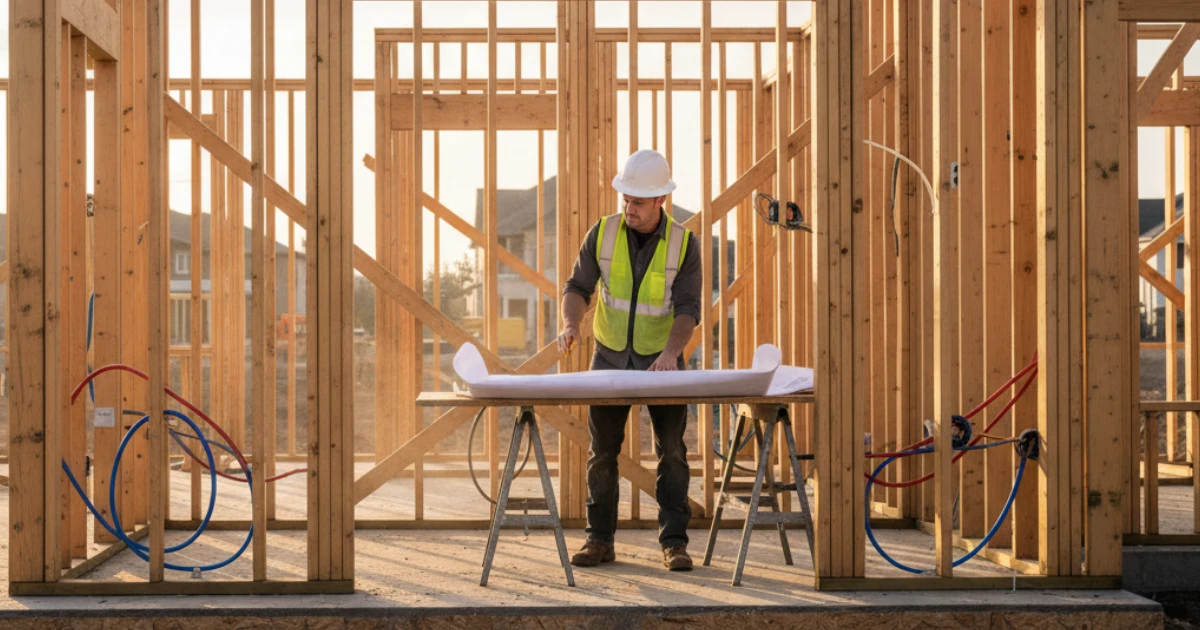
You're three weeks into framing. The walls are going up, the house is starting to take shape, and everything feels like it's moving fast. Your builder asks where you want the outlets in the kitchen island. You haven't thought about it yet.
"We'll figure it out later."
That sentence just cost you somewhere between $800 and $5,000. Because "later" in construction doesn't mean next week. It means after the drywall is up, after the tile is set, after the paint is done — and now changing anything means tearing finished work apart.
I've been building custom homes for over 15 years, and that phrase — "we'll figure it out later" — is the single most expensive sentence in residential construction. Not because the decisions are hard. Because the window to make them cheaply closes faster than anyone expects.
The most expensive sentence in construction is "we'll figure it out later."
1
Electrical Outlet and Switch Locations
Cost to change after drywall: $200 - $800 per outlet
Code requires an outlet every 12 feet. Your builder will put them exactly there — code minimum — unless you tell him otherwise. And "code minimum" means you'll be running extension cords to charge your phone at the nightstand, powering the Christmas tree from across the room, and discovering that the kitchen island has zero outlets.
During rough-in, adding an outlet costs $50-100. After drywall, it's $200-800 — cut the drywall, run the wire, patch, texture, repaint.
What your builder plans
Code minimum: one outlet every 12 feet along walls.
One outlet per bathroom vanity. One in the garage.
Standard switch at every door — nothing more.
What you actually need
Outlets every 6 feet. USB-C outlets at nightstands.
Dedicated circuits for kitchen island, home office, and garage workbench.
Outdoor outlets: front porch, back patio, eaves (Christmas lights), landscape lighting.
- Walk through your floor plan room by room. Where does your phone charge at night? Where do the lamps go?
- Kitchen: outlets on the island, outlets above the counter on every wall, dedicated 20A circuit for the microwave
- Garage: at least 4 outlets on each wall plus a 240V outlet for EV charging or tools
- Outdoor: front porch, back patio (both sides), soffit outlets for Christmas lights, landscape lighting circuits
- Floor outlets for living rooms with floating furniture (center couches, no wall behind them)
The #1 regret I hear from homeowners after move-in: not enough outlets. Not the countertops, not the paint color, not the flooring. Outlets. Because you use them every single day and there's no easy fix once the walls are closed up. Spend an extra $500-800 during rough-in to double your outlet count. You'll never regret it.
2
Plumbing Drain and Water Line Positions
Cost to change after slab: $2,000 - $8,000 per fixture
Drains go in before or during the slab pour. Once the concrete is set, moving a drain means jackhammering your foundation, relocating the pipe, repouring concrete, and praying you didn't compromise the structural integrity of the slab.
This is the most permanent decision on this list. Everything else can be fixed by opening walls. Drains under a slab? That's breaking your foundation.
If you're building on a slab (most of Texas, Florida, and the South), drains are literally encased in concrete. Crawl space homes have slightly more flexibility since pipes run underneath — but "slightly more flexible" still means $2,000+ per fixture. Plan your drains right the first time.
- Kitchen island sink: decide now if you want one — a drain in the island is a slab decision
- Wet bar or coffee bar: if there's any chance you'll want a sink, run the drain now
- Utility sink in the garage: $200 during slab work, $3,000+ after
- Outdoor shower or hose bibs: plan the drain locations and water lines
- Pet wash station: popular regret item — run the drain and hot/cold water during rough-in
- Future bathroom: if there's any chance of adding a bathroom later, put the drain stub in the slab now ($300 vs. $8,000 later)
3
HVAC Duct Routing and Vent Locations
Cost to change after drywall: $1,500 - $5,000
Ducts get hidden in walls, between floor joists, and above ceilings. Once drywall closes them in, they're invisible and inaccessible. The register (vent) location dictates furniture placement — a floor register under your couch means you're heating the bottom of your sofa, not the room.
And the return air location? If your HVAC return is in the hallway outside the master bedroom, you'll hear the air handler cycling on and off all night long.
| Room | Best vent placement | Avoid |
|---|---|---|
| Bedrooms | Under windows or along exterior walls | Where the bed or dresser will sit |
| Living room | Along exterior walls, away from seating | Center of the room (floor register under furniture) |
| Kitchen | Toe-kick registers under cabinets | In the floor where you stand while cooking |
| Bathrooms | Near the tub or under the vanity | Directly in front of the toilet |
| Master bedroom | Return air in master closet (quiet) | Return air in hallway outside bedroom door |
- Mark furniture locations on the floor plan first, then place vents around them
- Put return air grilles in closets or utility rooms — not hallways near bedrooms
- If you're doing a two-zone system, decide the zone split now (upstairs/downstairs or left/right)
- Ask your HVAC sub for a Manual J load calculation — this sizes the system properly and prevents hot/cold spots
4
Window Sizes and Positions
Cost to change after framing: $1,500 - $4,000 per window
Windows are framed into the structure — headers, king studs, cripple studs, the whole nine. Changing a window size means reframing the opening, modifying the exterior siding, adjusting flashing and weatherproofing, and often re-insulating the surrounding wall cavity. For one window.
The most common regrets: a bathroom window that's too low (no privacy), a bedroom window that's too big (where does the bed go against the wall?), and a kitchen window that's too high (can't see the kids in the backyard while standing at the sink).
- Bedroom bed walls: window sill at 36" or higher so a headboard fits underneath
- Bathroom windows: sill at 48" minimum for privacy (60" if the window faces a neighbor)
- Kitchen sink window: sill at 42-44" so you can see out while standing
- Don't put floor-to-ceiling windows on a wall where you'll need furniture against it
- Consider how each window looks from the OUTSIDE too — the front elevation matters for curb appeal and resale
Windows are ordered 4-8 weeks before installation. Once they're ordered, changing sizes means a restock fee ($200-500 per window), a new order with another 4-8 week lead time, and your build schedule just slipped a month. Finalize window sizes before they go to order — not after.
5
Ceiling Heights
Cost to change after framing: $5,000 - $15,000 per room
Standard ceiling height is 9 feet. Want 10-foot ceilings in the main living areas? That's a framing decision — the wall studs, top plates, and roof trusses are all sized for a specific ceiling height. You can't raise a ceiling after framing without reframing the entire roof system above it.
Vaulted ceilings, tray ceilings, coffered ceilings, dropped soffits over kitchen cabinets — these are all built during framing. After the fact, they're five-figure renovations.
If you can afford it, go 10-foot ceilings in the main living areas (kitchen, living room, dining room) and 9-foot in the bedrooms. The cost difference during framing is $2,000-4,000 for the whole house (taller studs + taller drywall). After framing, raising a ceiling in one room costs $5,000-15,000. The framing phase is your only affordable window.
- Main living areas: 10' ceilings if budget allows (the extra cost during build is minimal)
- Great room: vaulted or coffered? Decide now — both are structural
- Kitchen: dropped soffit above cabinets? This hides ductwork and looks clean, but it's framed
- Basement: if you have one, plan for at least 9' ceilings — 8' basements feel like bunkers
6
Load-Bearing Wall Placement
Cost to change after framing: $8,000 - $25,000
"We'll open it up later." I've heard this dozens of times. The homeowner moves in, lives with the layout for a year, and decides they want to knock out the wall between the kitchen and the living room. Then they find out it's load-bearing.
Removing a load-bearing wall means engineering a beam to carry the load, installing posts or columns to support it, potentially modifying the foundation to handle the new point loads, and pulling a permit. What was supposed to be a weekend demo project is now a $15,000-$25,000 structural renovation.
- The "open concept" decision is a framing decision, not a post-construction option
- If you THINK you might want a wall removed later — remove it now and use a beam from the start
- Ask your architect to clearly mark load-bearing vs. partition walls on the plans
- Headers above openings: wider openings need bigger headers (LVL beams or steel). Plan the opening size now.
I had a homeowner who wanted to open up the kitchen two years after move-in. The wall was load-bearing with a plumbing stack running through it — bathroom above. The estimate came back at $22,000. The same change during framing would have cost about $1,200 for a longer header beam. That's an 18x price multiplier for waiting.
Don't Leave These Decisions to Chance
The Home Building Checklist Bundle walks you through every phase of construction — so you know exactly what needs to be decided (and when) before it's too late.
See the Checklist Bundle
7
Bathroom Locations
Cost to change after framing: $5,000 - $15,000
Bathrooms aren't just rooms — they're plumbing infrastructure. Every bathroom needs drain stacks, vent pipes, hot and cold water lines, and sometimes dedicated electrical circuits (GFCI outlets, exhaust fans). Moving a bathroom after framing means relocating all of it.
Second-floor bathrooms are the most critical to plan correctly. They need to stack above first-floor wet walls (kitchen or lower bathroom) for the drain lines to work efficiently. Put a second-floor bathroom on the opposite side of the house from the plumbing stack and you're running drains horizontally through floor joists — expensive, noisy, and harder to service.
- Stack second-floor bathrooms directly above first-floor bathrooms or the kitchen
- Powder room placement affects the floor plan more than you think — it needs a drain in the slab
- Plan for a future bathroom? Run drain stubs during slab/rough-in ($300 now vs. $8,000 later)
- Every bathroom needs an exhaust fan vented to the exterior — plan the duct route during framing
8
Staircase Design and Location
Cost to change after framing: $10,000 - $30,000
A staircase is one of the most structural elements in a two-story home. It cuts through the floor system, needs headers at the top and bottom, and dictates the floor plan of both levels simultaneously. Moving a staircase after framing is effectively rebuilding two floors.
Width, tread depth, landing size, turn direction, railing style — these are all set during framing. A straight staircase takes different floor space than an L-shaped or U-shaped one, and each option affects what you can do with the space underneath.
The space under the staircase is usually wasted — but it doesn't have to be. A closet, a powder room, a pet nook, a wine storage area, or a reading nook all fit under stairs. But the framing has to accommodate it. If you frame the stairs without planning the space below, you end up with an awkward triangular closet full of vacuum cleaners. Plan both at the same time.
- Staircase style: straight run (takes the most linear space), L-shaped (compact), or U-shaped (most compact)
- Width: 36" is code minimum, 42" feels comfortable, 48" allows two people to pass
- What goes under the stairs? Plan this NOW so framing accommodates it
- Railing style: the framing for a cable rail vs. a solid baluster wall is different — decide before framing
9
Low-Voltage and Smart Home Wiring
Cost to change after drywall: $500 - $2,000 per run
CAT6 ethernet, coax cable, speaker wire, security camera cables, doorbell wiring, thermostat wiring — all of this runs through the walls during the same window as electrical rough-in. After drywall, running a single cable means fishing it through finished walls or exposed conduit on the outside.
Wi-Fi is NOT a substitute for hardwired connections. Your TV stutters during movie night. Your home office Zoom calls drop. Your security cameras lag. Hardwired is always more reliable — and the only time it's cheap to install is right now.
- CAT6 ethernet to every TV location, home office, and master bedroom
- Coax to the main TV location (some services still need it)
- Speaker wire to living room ceiling (surround sound), patio, and kitchen
- Security camera locations: run CAT6 to each exterior corner and the front door
- Doorbell: run low-voltage wire for a wired video doorbell (battery ones die constantly)
- Central wiring closet: one location where all cables terminate — usually a basement utility room or master closet
10
Soundproofing Between Rooms
Cost to change after drywall: $3,000 - $8,000 per wall
Interior walls in most new construction are just two sheets of 1/2" drywall on 2x4 studs with nothing between them. Sound travels through them like they're made of paper. You'll hear the TV from the living room in the master bedroom. You'll hear the laundry running from the home office. You'll hear the kids' music from the guest room.
Insulating interior walls costs $200-400 per wall during framing. After drywall? You're looking at $3,000-8,000 per wall — tear out one side of drywall, insulate, resilient channel, new drywall, tape, mud, texture, paint. Per wall.
You don't need to insulate every interior wall. Focus on: master bedroom wall shared with living area, bathroom walls (both sides), home office walls, laundry room walls, and any wall shared with the garage. These six areas cover 90% of noise complaints. Total cost during framing: $1,200-2,400. After construction: $18,000-48,000.
- Insulate key interior walls with fiberglass batts (same insulation as exterior walls)
- For serious sound control (home theater, music room): resilient channel + double drywall
- Don't forget ceilings between floors — footstep noise from upstairs is the #2 noise complaint
- Solid-core doors in bedrooms and offices make a huge difference vs. hollow-core
11
Exterior Door and Garage Placement
Cost to change after framing: $5,000 - $15,000
Exterior doors are structural openings — headers, king studs, cripple studs, flashing, weatherproofing. Moving one means reframing the opening, patching the exterior, and possibly modifying the foundation (for slab-on-grade, the door opening is formed into the concrete).
Garage placement is even more consequential. It affects the driveway approach, the front elevation, where you enter the house daily, and the entire flow of the first floor. Most people enter their home through the garage 10 times a day — that's 3,650 times a year. Getting that transition wrong affects your daily life more than almost any other decision.
- How do you actually enter the house daily? If it's the garage, that garage-to-kitchen transition is your most important path
- Do you need a side entry? Back door to the patio? Mudroom entry from the garage?
- Think about future accessibility — a step-free entry from the garage matters more than you think
- Garage: 2-car vs. 3-car, front-facing vs. side-entry — this changes the entire driveway and front of the house
12
Attic and Crawl Space Access
Cost to change after drywall: $1,000 - $4,000
Nobody thinks about the attic hatch location. Then your HVAC tech needs to service the air handler, and the only access point is in the master bedroom closet. Or you want to store Christmas decorations in the attic, and the pull-down stairs are in a narrow hallway that can't fit a large box.
A pull-down attic staircase in the hallway means cold air intrusion and noise every time the HVAC cycles. In the garage? Perfect — nobody cares about noise or cold air in the garage.
- Attic access in the garage is ideal — no cold air intrusion, no noise, easy to carry large items
- If garage isn't an option, a utility room or secondary closet works
- Avoid: master bedroom closet (noise), hallways (cold air), and rooms with vaulted ceilings (no attic above)
- Consider a pull-down staircase instead of a scuttle hole if you'll use the attic for storage
- Make sure there's a clear path from the access point to the HVAC equipment for service
I once had a homeowner who put the only attic access in a bedroom closet with a vaulted ceiling in the living room (no access from that side). The HVAC unit was above the living room. Every service call required the tech to walk through the master bedroom, through the closet, and crawl 30 feet across the attic. The HVAC company started charging extra. A $200 decision during framing became a permanent inconvenience.
Every Decision. Every Phase. One Checklist.
15 years of field experience in one download. The Home Building Checklist Bundle covers pre-construction through final walkthrough — 12+ detailed checklists, a budget tracker, and a materials list.
Get the Complete BundleWhat These Decisions Cost — During Framing vs. After Drywall
Every decision above is cheap during framing. Here's what it costs when you miss the window:
| Decision | During framing | After drywall |
|---|---|---|
| Electrical outlets/switches | $50-100 each | $200-800 each |
| Plumbing drains/water lines | $200-500 each | $2,000-8,000 each |
| HVAC duct routing | $100-300 | $1,500-5,000 |
| Window size/position | $0 (plan change) | $1,500-4,000 per window |
| Ceiling height | $2,000-4,000 (whole house) | $5,000-15,000 per room |
| Load-bearing walls | $500-1,200 (beam) | $8,000-25,000 |
| Bathroom locations | $0 (plan change) | $5,000-15,000 |
| Staircase design | $0-2,000 | $10,000-30,000 |
| Low-voltage wiring | $50-100 per run | $500-2,000 per run |
| Soundproofing | $200-400 per wall | $3,000-8,000 per wall |
| Exterior doors/garage | $0 (plan change) | $5,000-15,000 |
| Attic access | $100-300 | $1,000-4,000 |
| Total potential exposure | $3,200-9,100 | $42,700-132,800 |
That's a 10-15x cost multiplier for waiting. The "figure it out later" approach on just half of these decisions can easily add $40,000+ to your build — for changes that would have cost a few thousand dollars during framing.
The Decision Timeline — When Each One Locks In
Not all 12 decisions lock in at the same time. Here's when each window closes:
Before Foundation Pour
- Plumbing drain positions (slab-on-grade)
- Bathroom locations (drain stubs)
- Garage and exterior door placement
- Foundation size and layout (room sizes locked)
During Framing (2-4 weeks)
- Load-bearing wall placement
- Window sizes and positions
- Ceiling heights
- Staircase design and location
- Attic access location
Before Drywall (last chance)
- Electrical outlets and switch locations
- Low-voltage and smart home wiring
- HVAC duct routing and vent locations
- Soundproofing between rooms
- Plumbing rough-in (water lines in walls)
Before your builder hangs drywall, do a full walk-through of the framed house. This is your last chance to see every wire, pipe, duct, and stud. Bring your floor plan, a flashlight, and this article. Walk every room. Check every outlet location. Verify every vent position. Once drywall goes up, it's all hidden — and the cheap window closes forever.
For a complete guide on what to check at each construction stage, read my phase-by-phase inspection guide. And for the floor plan decisions that happen even earlier in the process, check out 10 floor plan mistakes that will cost you thousands.
Final Thoughts
"We'll figure it out later" isn't a plan. It's a blank check.
Every decision on this list has a cheap window and an expensive window. The cheap window is open for 2-4 weeks during framing and rough-in. The expensive window is open forever — but at 10 to 15 times the price.
The homeowners who come out of a custom build happy aren't the ones who spent the most money. They're the ones who made decisions at the right time. They walked the framing. They finalized the outlet plan before rough-in. They insulated the master bedroom wall before drywall. They ran CAT6 to every room while the walls were open.
You don't need to know everything about construction. You just need to know what to decide and when. That's the difference between a $300,000 build that feels like a $500,000 home and a $500,000 build that feels like a $300,000 one.
Make the decisions while the walls are open. Your future self will thank you.
For more on what the surprise costs look like, read my guide on the hidden costs of building a custom home.