Texas Owner-Builder Guide: How to Be Your Own General Contractor in 2026
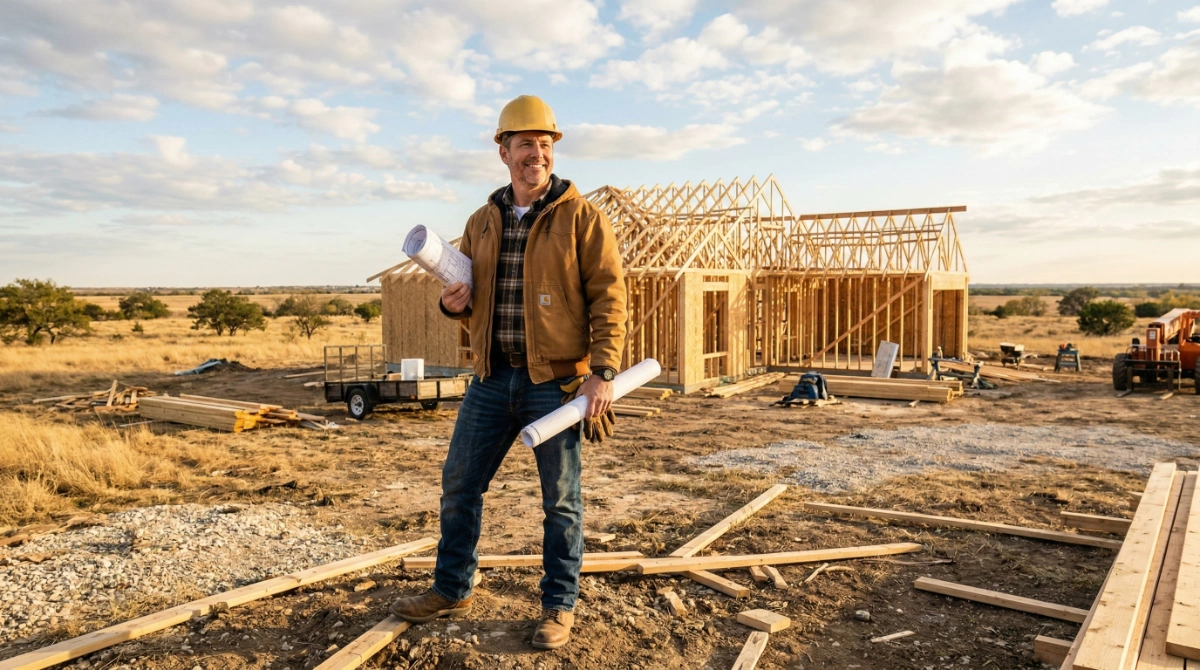
Texas is one of the only states in America where you can legally build your own home without a general contractor’s license. No exam. No state registration. No apprenticeship hours.
That single fact has saved thousands of Texan homeowners between $50,000 and $150,000 on their builds. It has also left some standing in a half-finished house with an empty bank account, no subcontractors returning their calls, and a construction loan ticking interest every month.
The difference between those two outcomes is not luck. It’s preparation.
(Texas requires none)
hiring a general contractor
experience cost overruns
This guide is the honest version. Not the version that sells you a dream. Not the version that scares you away. The version that tells you exactly what you’re getting into, what it costs, what can go wrong, and how to actually pull it off in the state of Texas.
This article contains real numbers, real laws, and real consequences. If you’re looking for a motivational “anyone can do it!” pep talk, this isn’t it. If you want the truth so you can make an informed decision, keep reading.
Why Texas Is Different From Every Other State
Most states require general contractors to pass exams, carry specific insurance, and hold a state-issued license. California, Florida, Arizona - all of them have licensing boards that can fine or jail you for contracting without credentials.
Texas doesn’t. There is no state-level general contractor license. Period.
This means:
- You can legally act as the general contractor on your own home
- You can hire, schedule, and manage all subcontractors yourself
- You can pull building permits in your own name (in most jurisdictions)
- You can save the 15-25% markup that a GC would have charged
But there’s a critical distinction that trips up nearly every first-time owner-builder:
Texas law requires state licenses for electricians, plumbers, and HVAC technicians. You can manage the project. You can hire and coordinate the trades. But you cannot wire your own panel, plumb your own house, or install your own HVAC system unless you hold the appropriate state license. Doing so is a Class C misdemeanor.
The Money: How Much Can You Actually Save?
Let’s talk numbers. On a $400,000 custom home build in Texas, here’s what the general contractor markup typically looks like:
| Cost Category | With GC | Owner-Builder | Difference |
|---|---|---|---|
| GC overhead & profit (20%) | $80,000 | $0 | -$80,000 |
| Materials markup (25-50%) | Contractor pricing | +5-10% retail | +$10,000-$20,000 |
| Budget overrun risk | ~10% | ~20-28% | +$20,000-$40,000 |
| Extended timeline interest | 8-12 months | 14-22 months | +$8,000-$15,000 |
| Realistic net savings | - | - | $20,000-$60,000 |
Notice that. The gross savings is $80,000. But the realistic net savings - after you account for retail material prices, higher overrun risk, and longer timelines - lands closer to $20,000-$60,000 for a well-prepared owner-builder.
That is still significant money. Enough for a pool. Enough for upgraded finishes throughout. Enough to justify the effort - if you go in prepared.
Nobody counts your time. Managing a custom home build is a 15-25 hour per week job for 12-18 months. If your professional hourly rate is $75/hour, that’s $45,000-$97,500 in unpaid labor. For some people, the math still works. For others, it doesn’t. Be honest with yourself.
How Long Will It Actually Take?
U.S. Census Bureau data doesn’t sugarcoat it. Owner-built homes take significantly longer than contractor-managed builds:
Why so much longer? Three reasons:
- You have a day job. A full-time GC is on site daily. You’re managing between meetings, on lunch breaks, and on weekends.
- Subs don’t prioritize you. A one-time owner-builder is always lower priority than a contractor who sends them 10 jobs a year. When there’s a schedule conflict, guess whose job gets bumped.
- The learning curve is steep. Every decision takes longer when it’s your first time. A GC makes 50 calls a week without thinking. You’ll agonize over each one.
Don’t Wing It. Use the Checklist That Covers Every Phase.
200+ inspection points, organized phase by phase. Built by someone who has managed builds from foundation to move-in. Includes budget tracking, contractor interview templates, and the questions your subs hope you won’t ask.
Get the Home Building ChecklistThe 6-Step Owner-Builder Roadmap for Texas
Here’s the process, step by step. No filler. No fluff. Just the sequence that works.
Texas has no statewide building code. Each city, county, and jurisdiction adopts its own. This is the single most confusing aspect of building in Texas, and the one that catches more owner-builders off guard than anything else.
Here’s how the four largest Texas cities compare:
No zoning laws (largest US city without zoning)
No contractor registration required
Permits: project-by-project basis
Avg cost: ~$250/sqft
Contractor registration: $170/2 years
Requires $500K liability insurance
Has zoning, 2021 building codes
Avg cost: ~$200/sqft
City contractor registration required
Has zoning, 2021 building codes
Inspections at every phase
Avg cost: ~$300/sqft
All contractors must register before pulling permits
Comprehensive zoning, 2021 codes
Longest permit processing times
Avg cost: ~$350/sqft
Unincorporated areas are a different world entirely. Texas counties generally cannot regulate residential construction in unincorporated areas. In many rural Texas counties, the only “building permit” you need is a septic system permit from TCEQ. No inspections. No code enforcement. No Certificate of Occupancy.
Here’s the part nobody talks about in owner-builder articles: most banks will not give you a construction loan.
Not because of your credit. Not because of your income. Because you’re not a licensed builder, and banks have seen too many owner-builder projects fail mid-construction - leaving them with an unlendable, half-finished structure as collateral.
| Loan Aspect | Reality for Owner-Builders |
|---|---|
| Down payment | 20-25% of total project cost (higher than standard 10-15%) |
| Interest rate | 10.25-11.25% (construction rate, not permanent mortgage rate) |
| Lender availability | Large banks: almost never. Small/community banks: sometimes. Credit unions: your best bet. |
| “Builder of Record” | 99% of Texas lenders require an experienced builder to oversee draw disbursements |
| Credit score minimum | 680+ (most lenders), 700+ for best terms |
The workarounds that actually work:
- Cash build: If you have the capital, you eliminate the single largest headache of owner-building. No draw schedules. No bank inspections. No “builder of record” requirements. This is how most successful owner-builders do it.
- Home equity / HELOC: If you own a primary residence with significant equity, borrowing against it to fund construction avoids the construction loan process entirely.
- Land as equity: If you own the land outright, some lenders count it toward your down payment.
- Phased construction: Build the shell (foundation, framing, roof, mechanicals) with a smaller loan. Finish the interior with cash over time. Common in rural Texas.
You are the general contractor. But you are legally required to hire state-licensed professionals for the following trades:
| Trade | Licensed By | Why It Matters |
|---|---|---|
| Electrician | TDLR (TX Dept of Licensing) | Working without license = Class C misdemeanor |
| Plumber | TSBPE (TX State Board of Plumbing Examiners) | Must hold Responsible Master Plumber license + $300K insurance |
| HVAC Tech | TDLR | Minimum 48 months practical experience required for license |
| Septic Installer | TCEQ | Required statewide for any on-site sewage facility |
| General Contractor | No state license | That’s you. No license needed. |
| Framing | No state license | Hire based on references and portfolio |
| Roofing | No state license | Some cities require registration |
| Concrete / Foundation | No state license | Critical to get right - verify experience on Texas clay soil |
Before any subcontractor touches your site, collect:
- Copy of their state license (verify online at TDLR.texas.gov or TSBPE.texas.gov)
- Certificate of Insurance (general liability + workers’ comp)
- Written contract with scope, price, timeline, and payment schedule
- At least 3 references from recent projects
In incorporated Texas cities, you’ll typically need all of the following permits:
- Building permit (new construction)
- Electrical permit
- Plumbing permit
- Mechanical/HVAC permit
- Septic permit (TCEQ - if no municipal sewer)
- Driveway/access permit (county or TxDOT)
- Floodplain development permit (if applicable)
- WPI-8 Windstorm Certificate (14 coastal counties only)
In unincorporated areas, you may only need the septic permit and potentially a plumbing permit. But “no building code” does not mean “no rules.” State electrical and plumbing licensing requirements apply everywhere in Texas.
Insurance You Need (Even Though Texas Doesn’t Mandate It)
Texas is one of the few states that does not require workers’ compensation insurance for private construction. That sounds like a cost savings. It’s actually a massive liability risk:
- If a worker is injured and you have no workers’ comp, you can be sued directly with unlimited personal liability
- As a “non-subscriber” (no workers’ comp), you lose key legal defenses including contributory negligence and assumption of risk
| Insurance Type | Required? | What It Covers |
|---|---|---|
| Builder’s Risk | No (but essential) | Fire, weather, theft, vandalism during construction. Cost: 1-5% of build cost. |
| General Liability | Some cities require it | Third-party bodily injury and property damage. Standard: $1M per occurrence. |
| Workers’ Comp | No (but strongly recommended) | Covers worker injuries. Without it, you face unlimited personal liability. |
Track Every Permit, Inspection & Payment in One Place
The Home Building Checklist includes phase-by-phase inspection points, a budget tracker, and contractor documentation templates. Stop managing your build on sticky notes.
See the Complete ChecklistThe number one reason owner-builder timelines spiral is incorrect sequencing. Trades must arrive in the correct order. If your plumber shows up before framing is complete, you’re paying them to stand around. If your drywall crew shows up before the electrical inspection passes, you’ll tear it all out again.
The correct Texas build sequence:
- Site prep & excavation - Clear, grade, and prepare the building pad
- Foundation - Slab-on-grade (most of Texas) or pier-and-beam. Get the geotechnical soil report FIRST.
- Framing - Walls, roof structure, windows, exterior doors
- Roofing - Get the building dried in as fast as possible (Texas storms)
- Rough-in: Plumbing -> HVAC -> Electrical - In that order. Pipes are hardest to move. Then ducts. Then wires.
- Insulation inspection -> Insulation - After all rough-ins pass inspection
- Drywall - Hang, tape, texture, prime
- Interior finish: Cabinets -> Counters -> Tile -> Trim -> Paint
- Flooring - After all ceiling and wall work is complete
- Final mechanical trim - Outlets, fixtures, HVAC registers
- Final inspections -> Certificate of Occupancy
- Landscaping & driveway - Last, so heavy equipment doesn’t destroy it
Texas has some of the strongest mechanic’s lien laws in the country. A subcontractor or supplier who isn’t paid can place a lien on your property - even if you already paid the contractor who hired them.
As an owner-builder, you’re the top of the payment chain. This is simultaneously your greatest protection and your greatest exposure.
Six rules that protect you:
- Written contracts with every subcontractor. For your homestead, a mechanic’s lien can only attach if there’s a written contract signed by you AND your spouse (if married), executed before work begins and filed with the county. No written contract = no valid lien on your homestead.
- Retain 10% of every payment. Texas law requires property owners to retain 10% of the contract price for 30 days after completion. This retainage fund protects you against unpaid subcontractor claims.
- Get lien waivers with every payment. Every time you pay a subcontractor, get a signed lien waiver. Every time.
- Use joint checks. Pay subs with checks made payable to both the sub and their supplier. This ensures the lumber yard actually gets paid.
- Verify subs paid their people. Before releasing final payment, confirm that your subcontractor has paid their own laborers and material suppliers.
- Record the original contract with the county clerk. Especially for homestead property.
The Texas Challenges Nobody Warns You About
1. Expansive Clay Soil (The Foundation Killer)
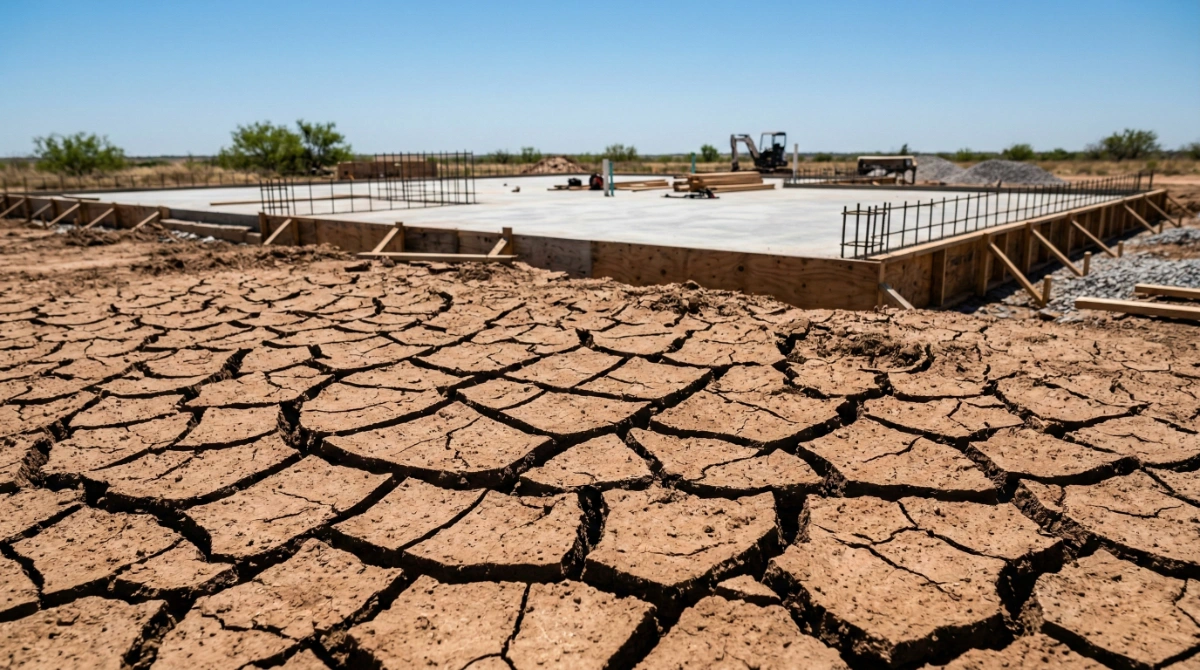
Much of Texas - particularly DFW, Houston, San Antonio, and Austin - sits on top of expansive clay soil. This isn’t a minor inconvenience. According to the American Society of Civil Engineers, expansive soils cause more financial damage to structures annually than floods, hurricanes, tornadoes, and earthquakes combined.
- Montmorillonite and bentonite clays expand dramatically when wet and contract when dry
- This cycle creates heaving and settling that cracks foundations, buckles walls, and jams doors
- A geotechnical soil report ($1,500-$3,000) is essential before foundation design - not optional
- Foundation solutions: post-tensioned slab-on-grade, pier-and-beam with drilled piers to bedrock, or structural slab with moisture barriers
2. Extreme Heat (It Affects Everything)
- Summer temperatures regularly exceed 100°F across most of Texas
- Concrete curing is affected - may need dawn pours and wet curing blankets
- Worker productivity drops 30-40% in peak summer heat
- Material costs increase when lumber warps, adhesives fail, and roofing materials become too hot to handle
- Home orientation, radiant barriers, and high-SEER HVAC are not luxuries - they’re necessities
3. Hurricane Zones (14 Coastal Counties)
If you’re building in any of the 14 First Tier coastal counties (including Galveston, Brazoria, Cameron, Nueces, and parts of Harris County), you must comply with the Texas Department of Insurance Windstorm Inspection Program.
- Requires a WPI-8 Certificate of Compliance to qualify for windstorm insurance through TWIA
- Must meet ASCE 7 wind load standards - significantly stricter than inland codes
- Within 1 mile of the Gulf of Mexico = High Velocity Hurricane Zone with even more stringent requirements
- Houston adopted stricter wind and flood standards after Hurricane Harvey - the first Texas city to do so
4. The Patchwork Code System
There is no single “Texas building code.” The state baseline references the 2012 International Residential Code. Cities can adopt newer versions and amend them. Many rural areas have no codes at all.
different code enforcement
(many cities use 2021)
unincorporated areas
This sounds like freedom. It can also be a trap. Building with no code enforcement means no inspections - which means no one catches the framing crew’s mistake until the wall cracks in year three. And good luck getting the bank to finance a home with no Certificate of Occupancy in some markets.
Should YOU Be an Owner-Builder?
Let’s be brutally honest about who this works for and who it doesn’t.
Good Candidate If...
- You have construction or project management experience
- You can dedicate 15-25 hours/week for 12-18 months
- You have cash reserves or strong financing
- You can handle confrontation (firing subs, negotiating disputes)
- You have an existing network of reliable trades
- You’re organized, detail-oriented, and patient
Think Twice If...
- Your only experience is watching HGTV
- You’re building on a tight budget with no contingency
- You can’t take time off work for site visits
- You avoid confrontation and negotiation
- You don’t know anyone in the trades
- You’re building in a city with strict permit processes (Austin)
The 15-25% savings is real. But it’s only realized by people who treat this like a second job with real consequences. The owner-builders who fail almost always share the same trait: they underestimated the time, the complexity, and the emotional toll.
Managing Your Own Build? This Is Your Project Manager in a Box.
The Home Building Checklist was built for exactly this situation. Phase-by-phase tracking, inspection checklists, budget worksheets, and the questions you need to ask every subcontractor before they start. Used by 3,200+ homeowners and builders.
Get the Home Building Checklist - $99Final Thought
Texas gives you more freedom to build your own home than almost any other state. That freedom is real, and the savings are real. But freedom without preparation is just chaos with a permit.
The owner-builders who succeed in Texas share three things: they researched before they broke ground, they hired licensed trades for the work that requires it, and they tracked every dollar, every inspection, and every decision along the way.
The ones who failed? They thought the hard part was the building. It wasn’t. The hard part was the planning.
Plan first. Build second. And never, ever skip the soil report.
For more on protecting yourself during a build, read our guide on the hidden costs of building a custom home and what to inspect at every stage.